Author: Whatcom Hort Society

  • #4 Robin and Gordon Plume
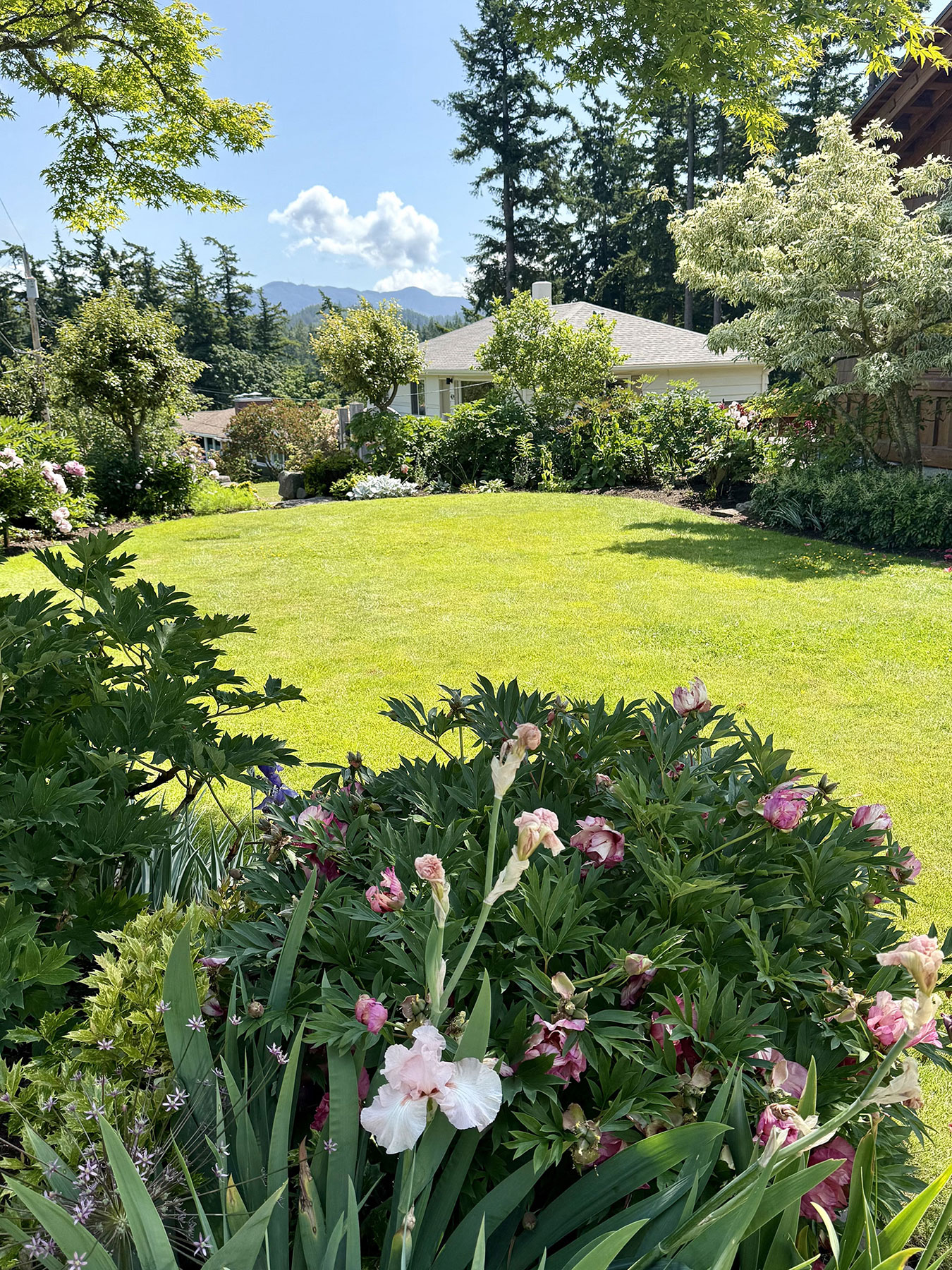

    Visitors can be dropped off at the address, but parking is at the Fairhaven Middle School lot. Walk .3 miles up the hill to 413 Parkridge or take the shuttle.

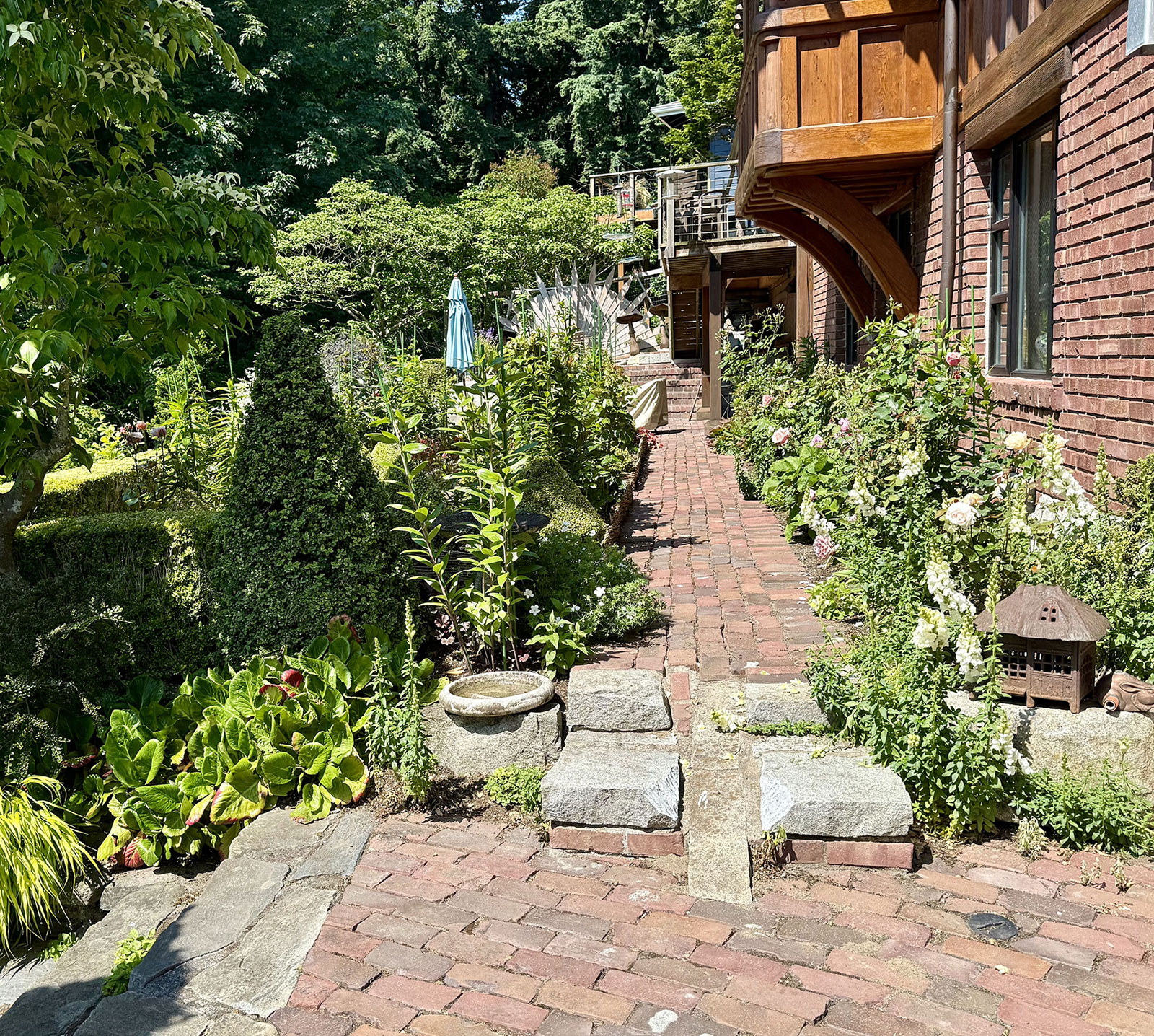
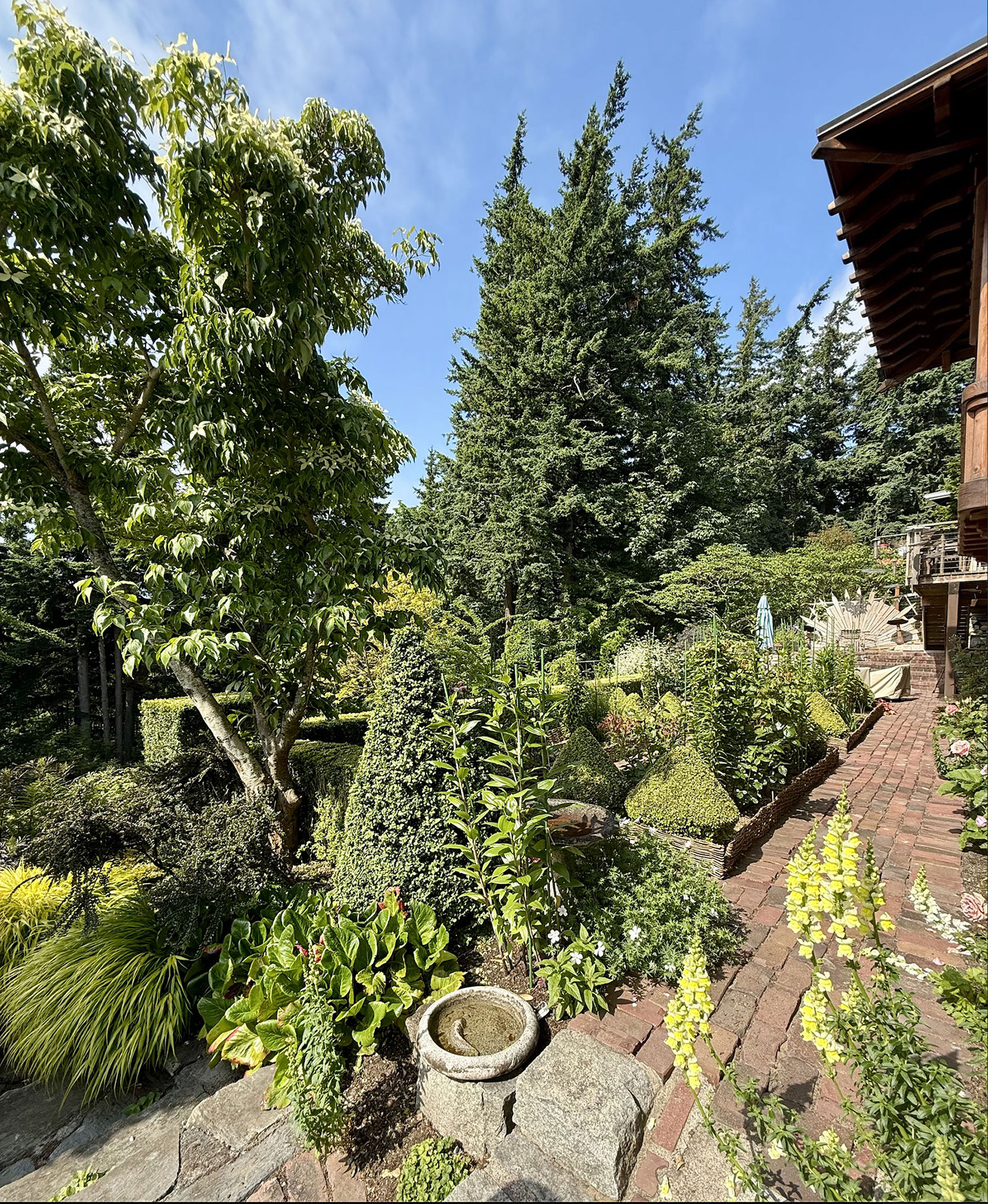
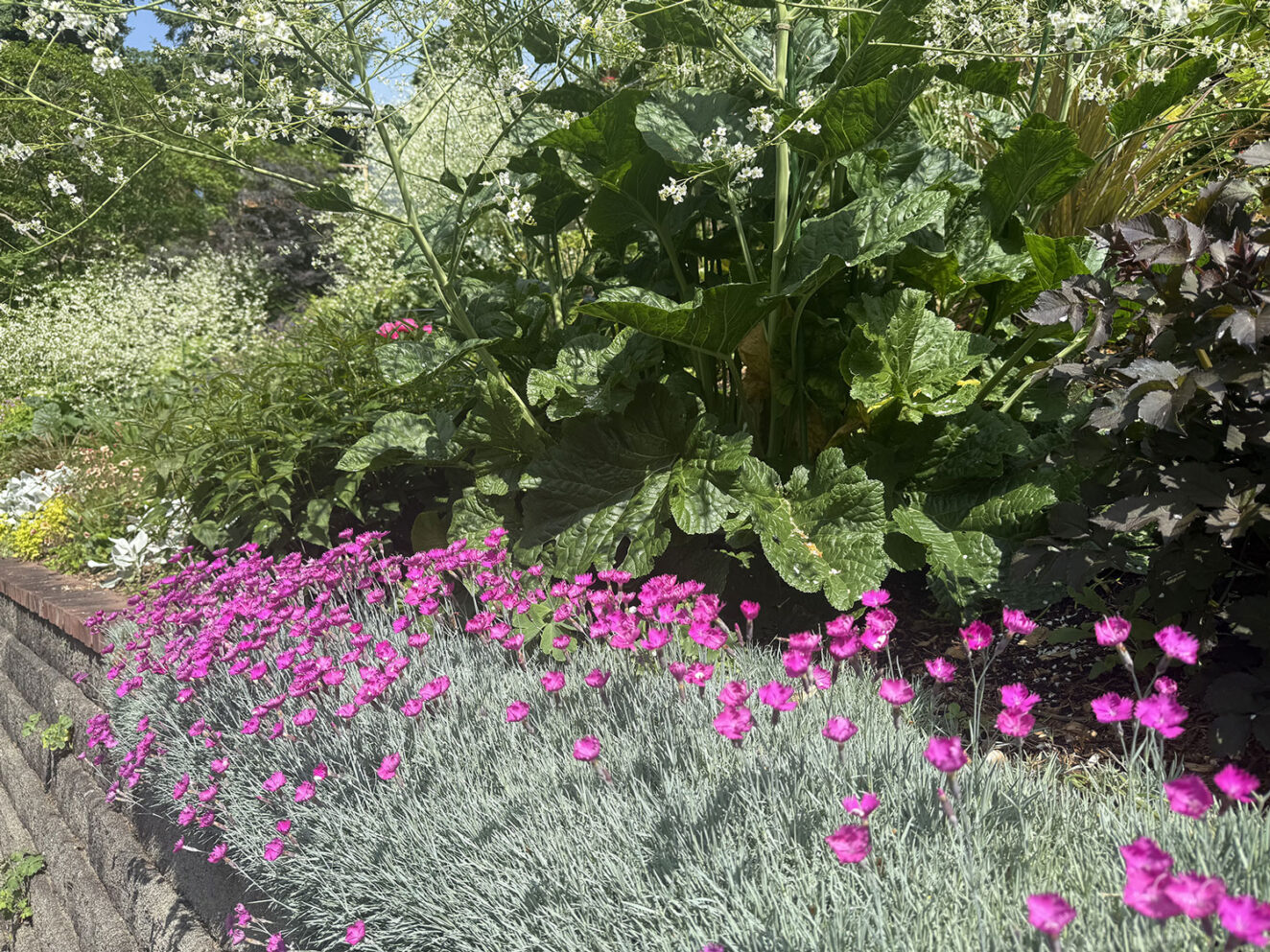
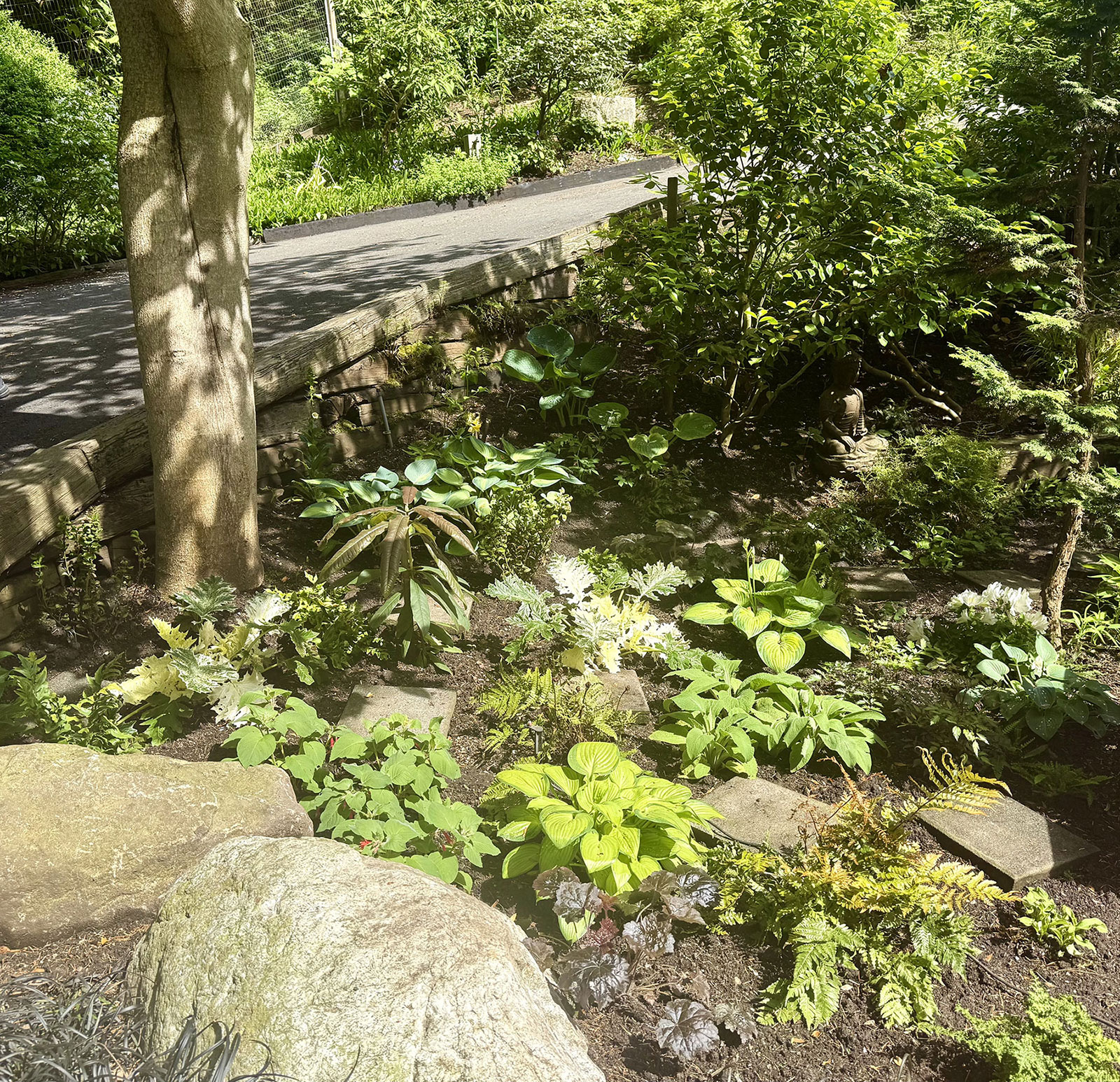
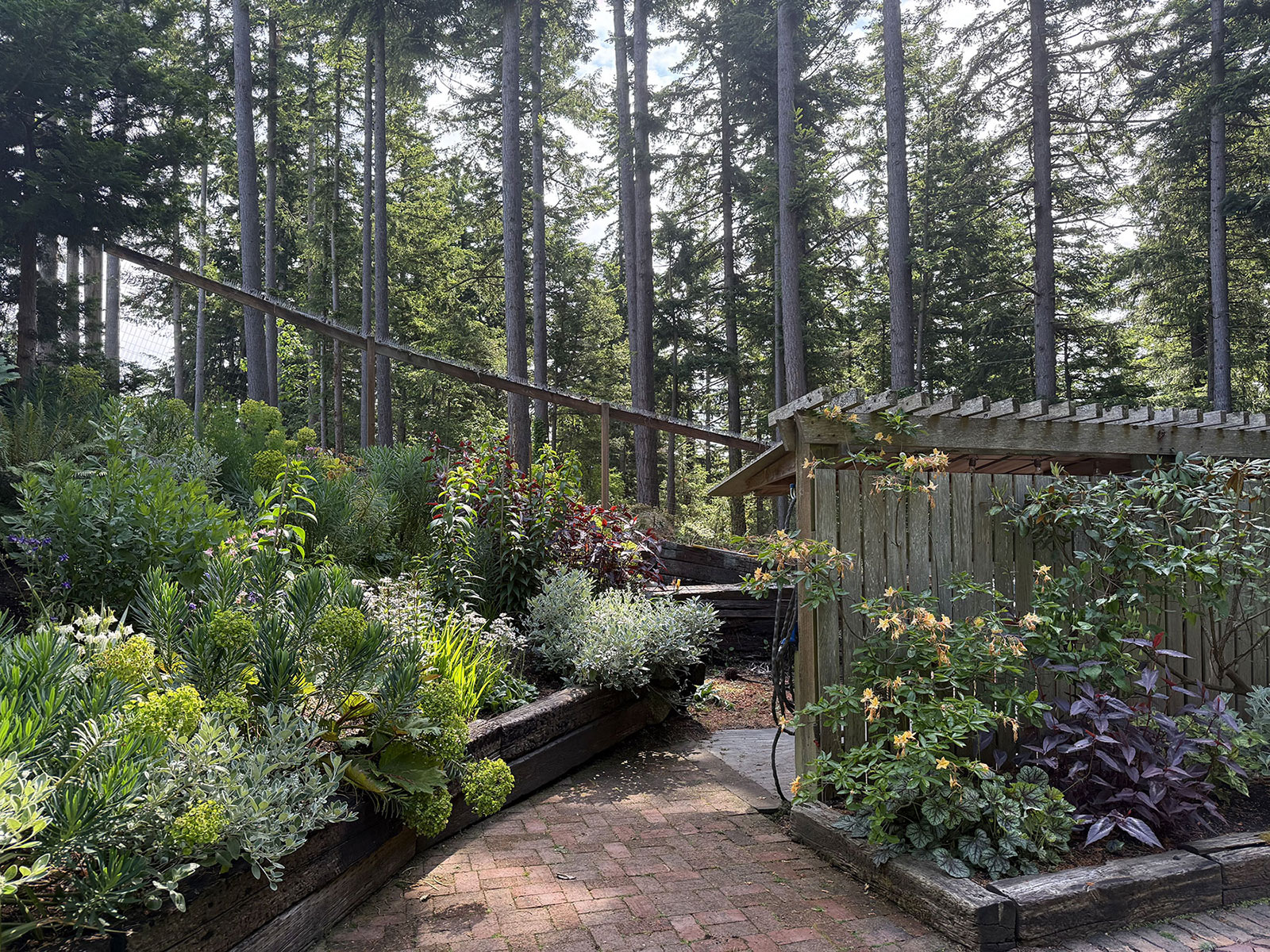
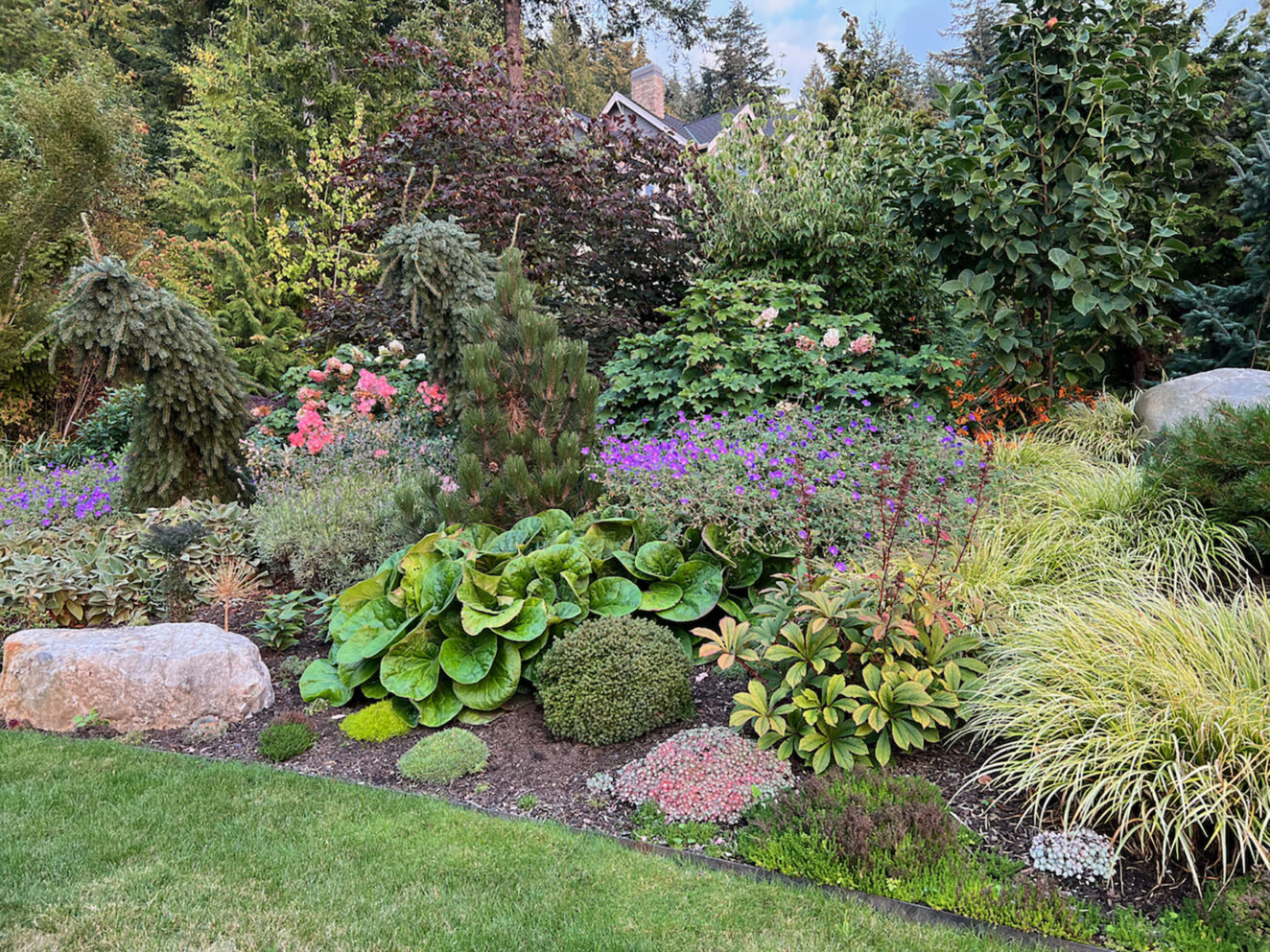
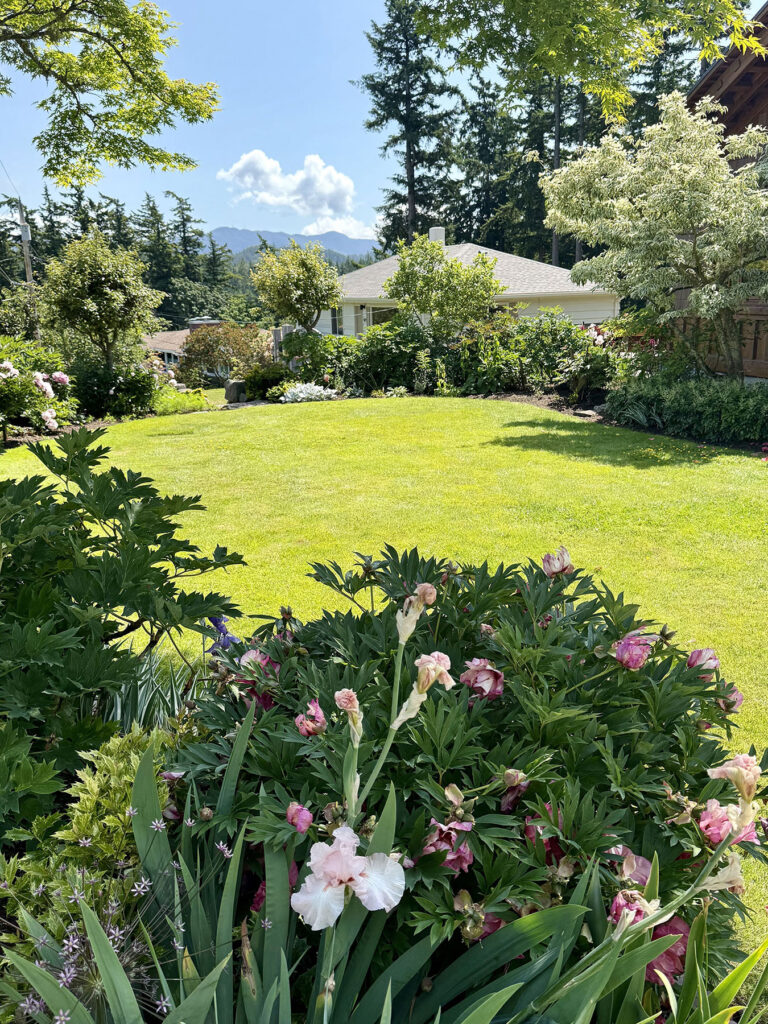
    You will be awed and amazed by this garden! Passionately built over the past 30+ years by a serious gardener and a renowned builder, it combines strong structural bones and thoughtful plant choices providing year-round appeal. Although the half acre lot is steeply sloped, it is very accessible due to creative terracing solutions. Each part of the garden reflects its name and nature. There is the Rose with clipped box, the French with clipped Hornbeam and bubbling fountain, and the Kitchen with espaliered fruit trees and greenhouse. As you walk into the lower garden, notice the newly planted bed with hostas, ferns, and a species rhododendron by the firepit and playhouse. Look up to take in the expansive Mediterranean hot slope with the more rare and unusual plants mixed in throughout. This is also a garden for the craftsman. Unique structures, from the tool house crafted with timber-end blocks to the Palladian Folly with turned columns, offer a glimpse of genius that is given free rein.
  • #5 Amy and David Gould

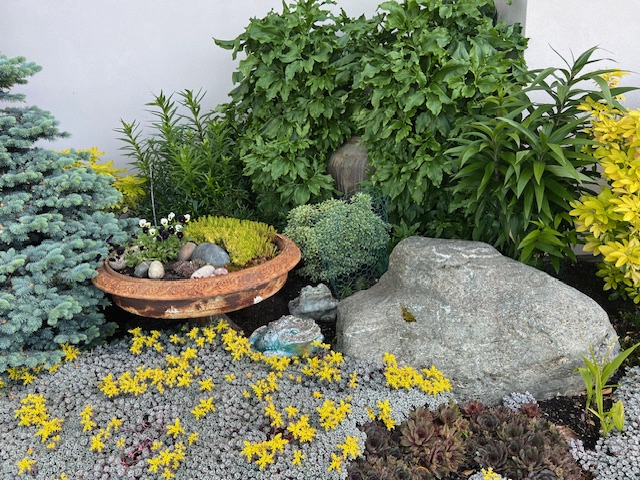
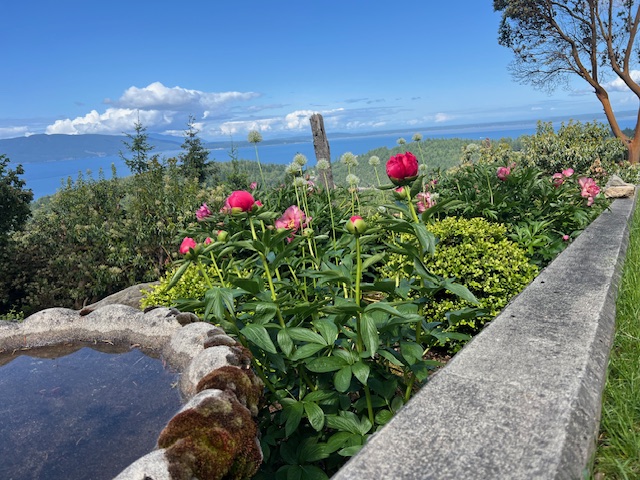
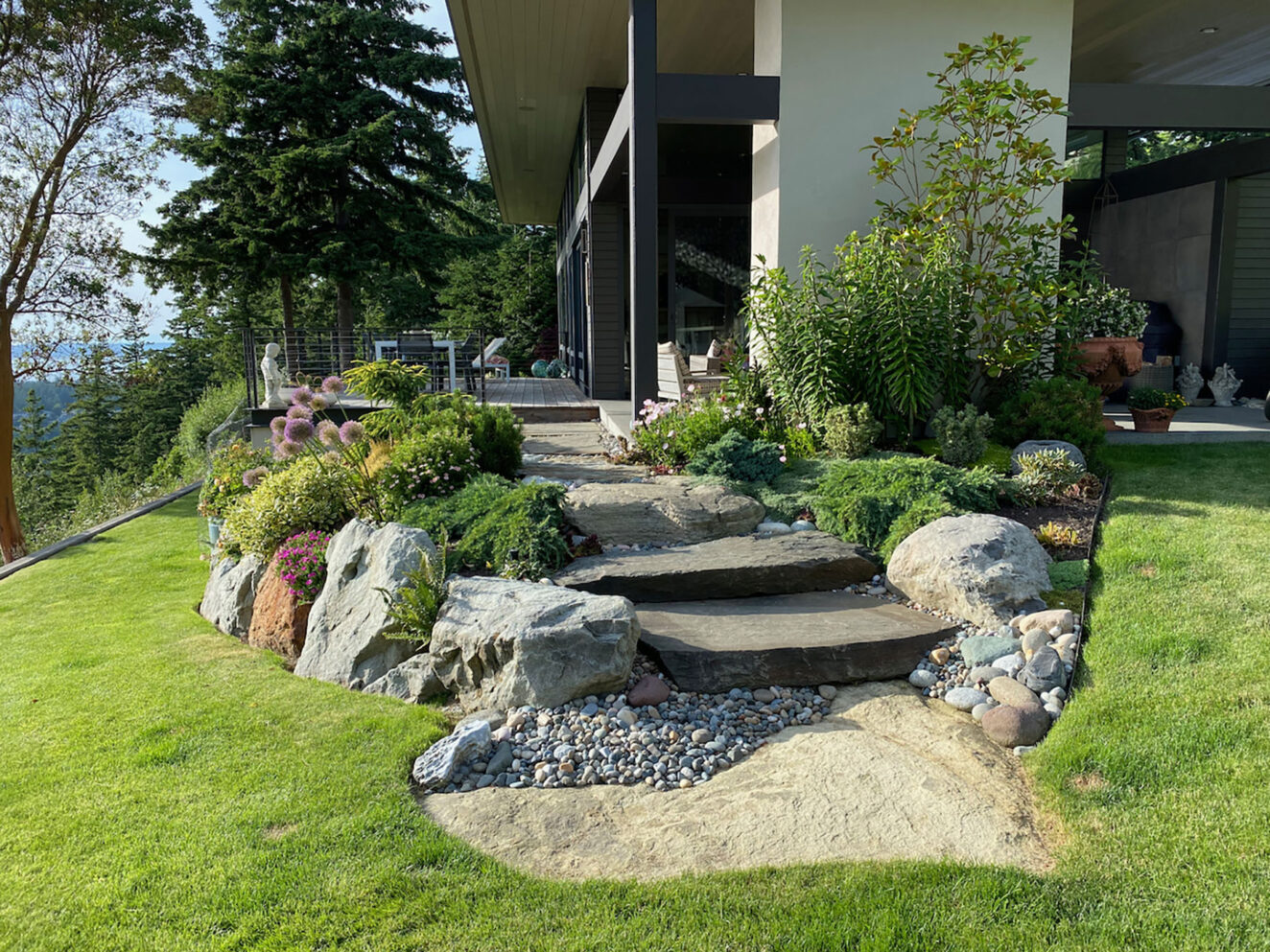
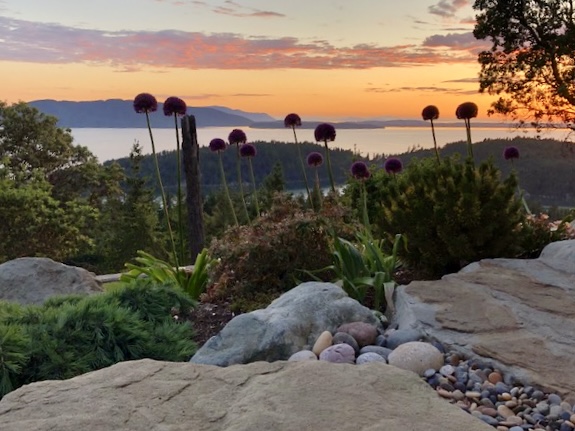
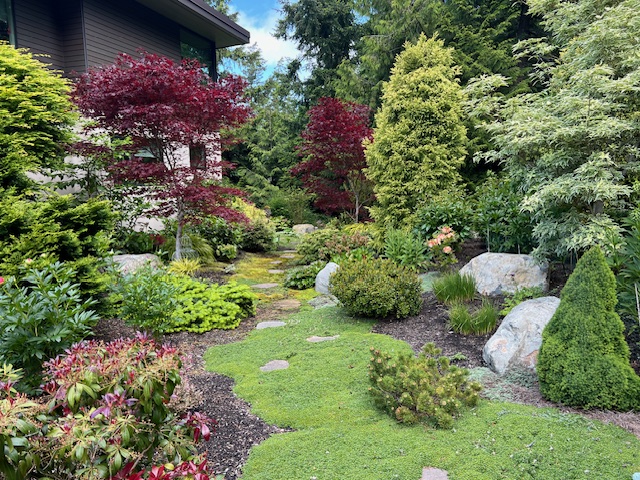
    Even with a big water view your attention will be captured by this garden’s artistry and creativity.  8 years ago, the work began on top of a flat shelf of native sandstone.  First, a lot of good soil was added, topographies formed, and then Amy could finally employ the exciting collection of local boulders and flat slabs collected over the several years prior which were used to fabricate the hardscaping, anchor trees, and define different areas.  Amy wanted to create a garden using lower maintenance plants, but without sacrificing anything aesthetically. Plant diversity, color, texture, flowers, and fragrance are all present throughout the year.  Because she’s an incurable collector of unusual things, you will see many vignettes of special plants, garden ornaments, and pots that make this such a creative and unusual place. Enjoy wandering through the different areas, sun and shade, winding pathways, and under tree canopies, and seeing all of the surprises. Look for a swing that’s not for the faint-hearted. 

    David’s well-tended veggie garden troughs sit in front of a stucco wall which captures the sun’s warmth and gives support to sugar snap peas and tomato plants, and he’s recently planted raspberries and blueberries below the nearby retaining wall.  Don’t forget to look across the cul de sac at the beautiful fern carpeted ravine with a swing that’s not for the faint hearted.

  • Spring Lecture Series ~ May 29 ~ Marryn Mathis

    Marryn Mathis

    “How to Successfully Grow Dahlias and Sweet Peas”

    Thursday May 29, 2025
    Whatcom Museum • 121 Prospect Street
    7:30pm • Doors open at 7
    Tickets: $10 Members • $15 General

    ”Whether it’s growing your own garden, creating handmade bouquets to share, or learning how to grow a new variety – flowers are so much more than just beautiful blooms. They represent hope, nostalgia, and a feeling of coming home to the place you belong.“

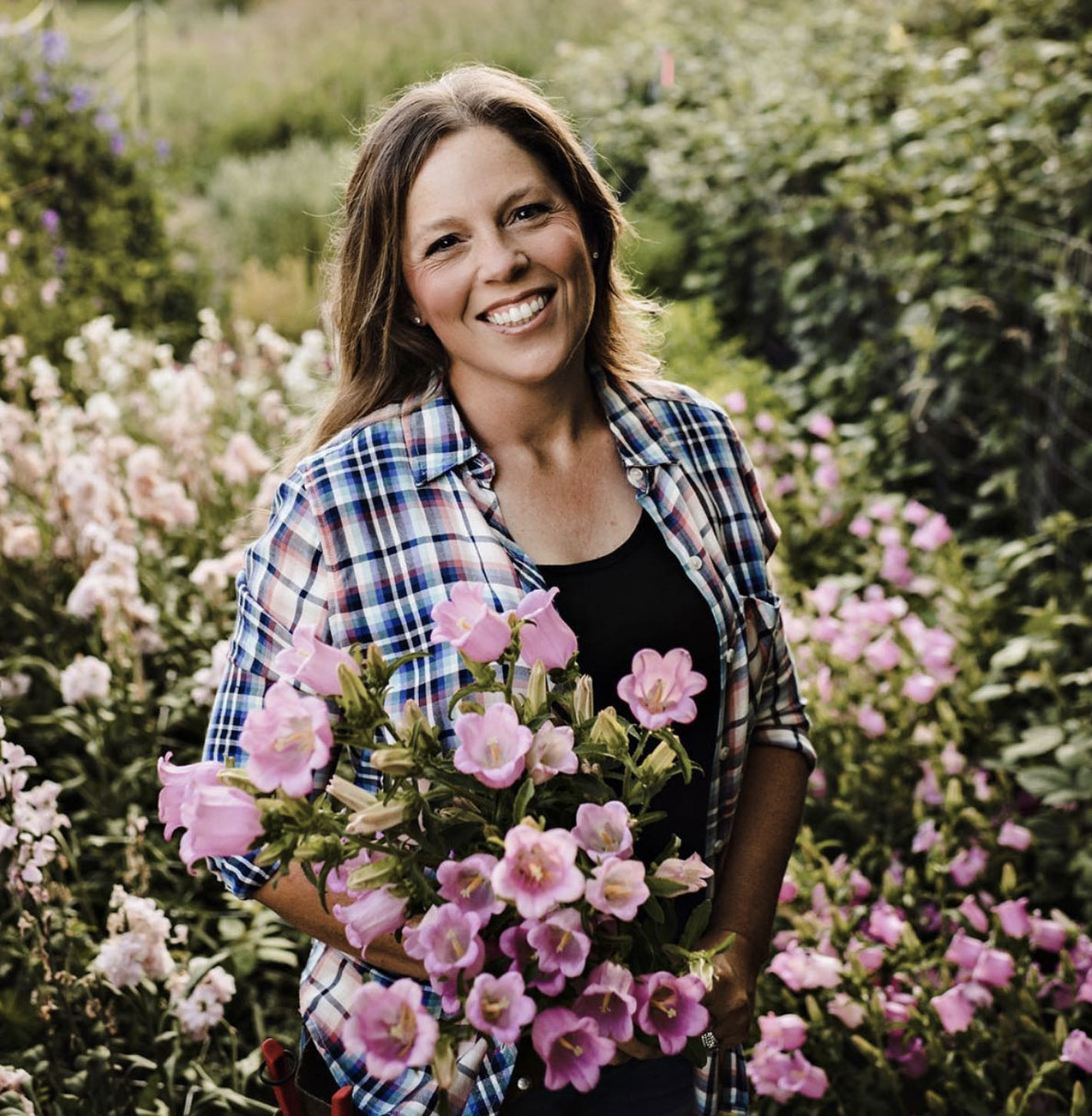
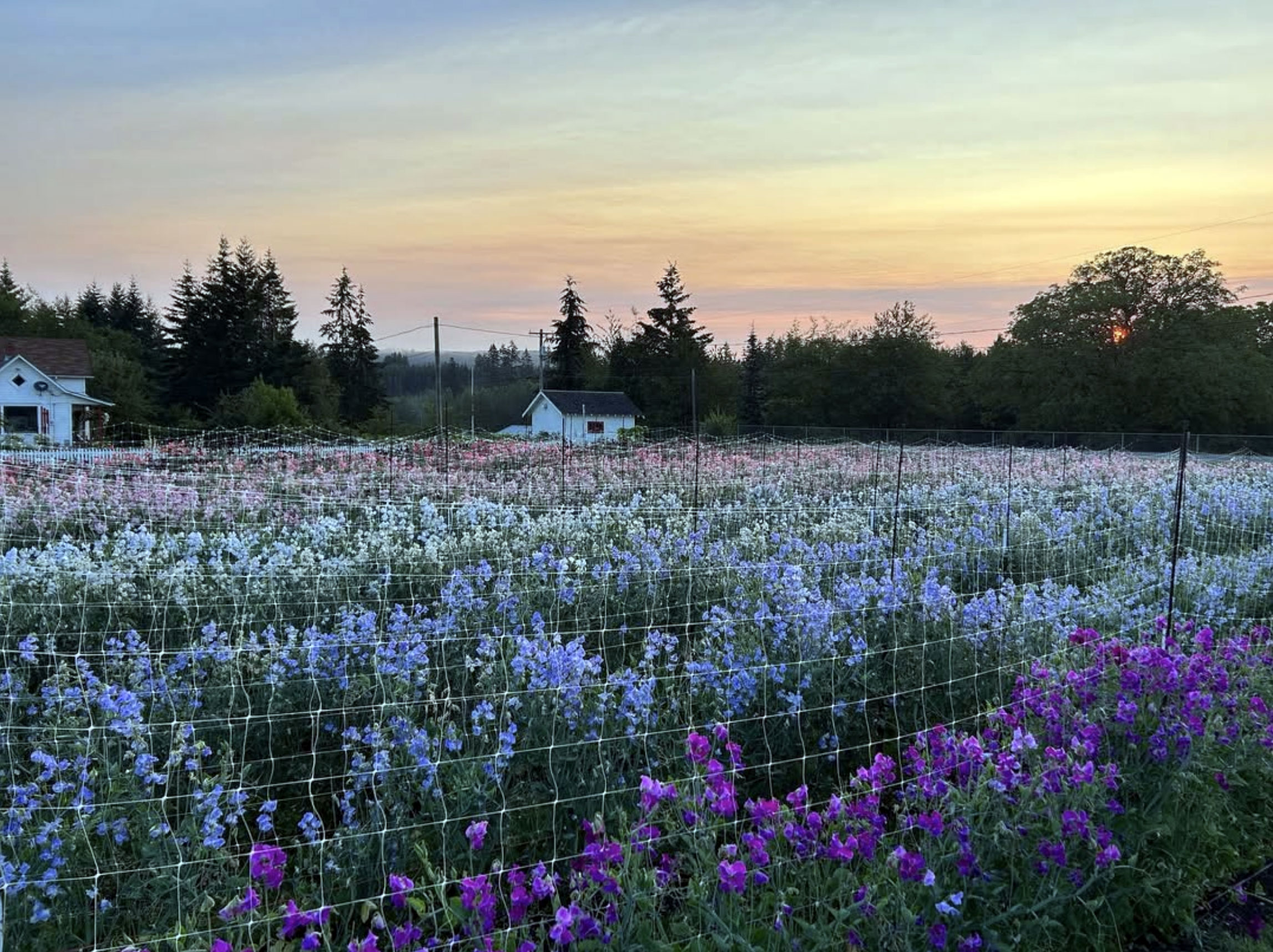
    We are so exited to welcome the exceptional local flower grower and author Marryn Mathis to tell us all things about growing sweet peas and dahlias. Marryn, known for her incredible dahlia field and amazing sweet peas, is also a cut flower educator who created the very unique sweet pea school. At her flower farm she specializes in seed production, growing cut flowers for retail, dahlia hybridization and educational workshops. Now the “Queen of Growing Sweet Peas” has published a new book: Sweet Pea School: Growing and Arranging the Garden’s Most Romantic Blooms that will be available at our lecture.

    Marryn Mathis and her family run the Farmhouse Flower Farm in Stanwood, Washington. She always loved flowers and gardening, but it took 20 years of working in healthcare and IT to finally realize what truly fed her soul—being among the flowers. She came alive and found her true passion when she discovered flower farming. In 2018 she founded the Farmhouse Flower Farm that specializes in dahlia tubers, flower seeds, sweet pea seeds, anemone, and ranunculus corms.

    Learn more at www.thefarmhouseflowerfarm.com

    Marryn Mathis Lecture Tickets May 29, 2025

  • Plants & Climate

    Written by Sylvia Briggs-Bauer

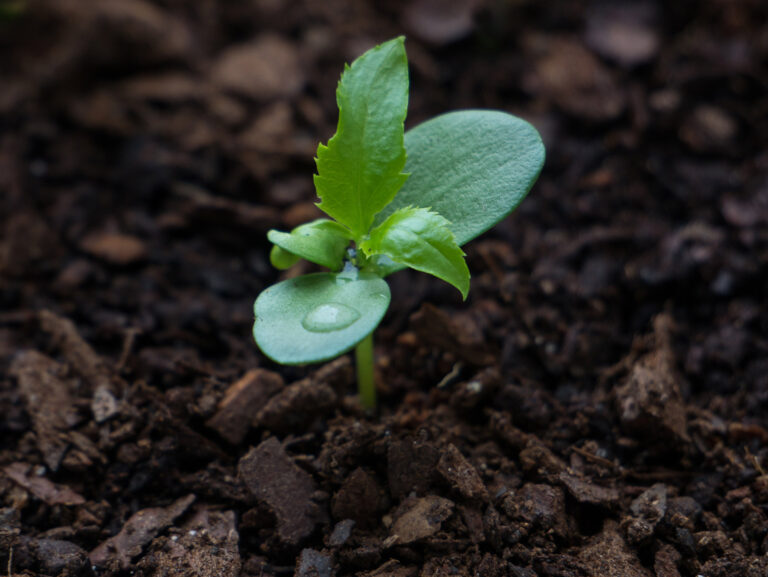
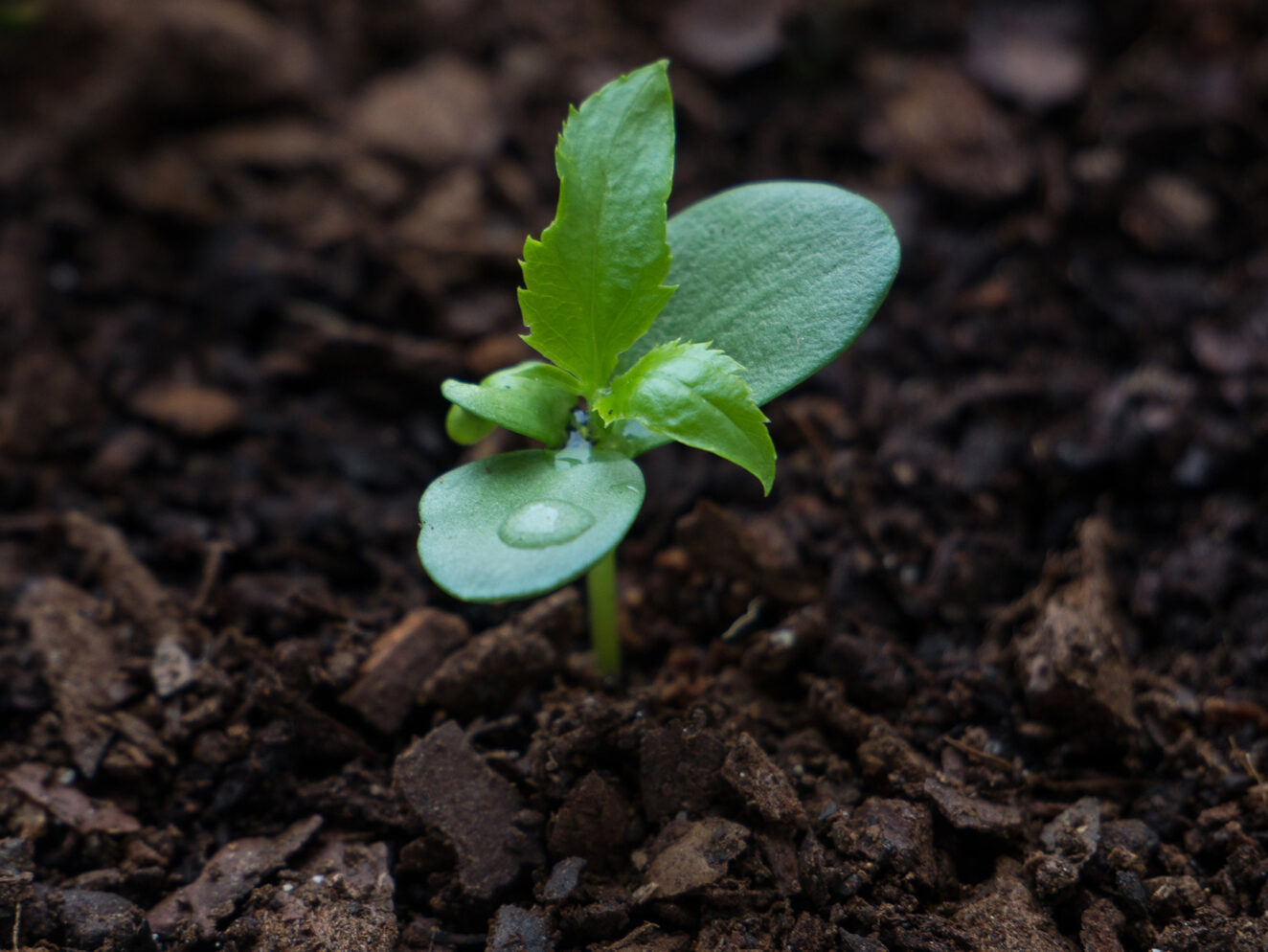
    Once I planted the seed of an apple I thought tasted delicious. My thinking was that it would grow to produce more delicious apples. Even when my parents informed me that store-bought apples seeds didn’t usually produce fruits, stubbornly I continued my mission, thinking I would at least create a cool bonsai tree. When the sprout was around two years old, I thought it was time to let it grow outside (although it was only an inch or two tall). It was summer after all, it wasn’t like the little tree would freeze and die, right?  Much to my regret, the leaves of the plant burned in the sun, and no matter how much I tried to bring it back to life, the little twig never grew another leaf again. 

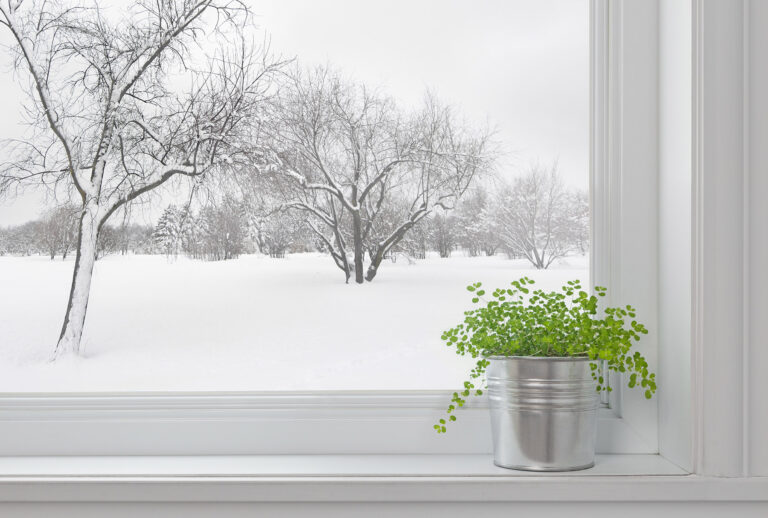
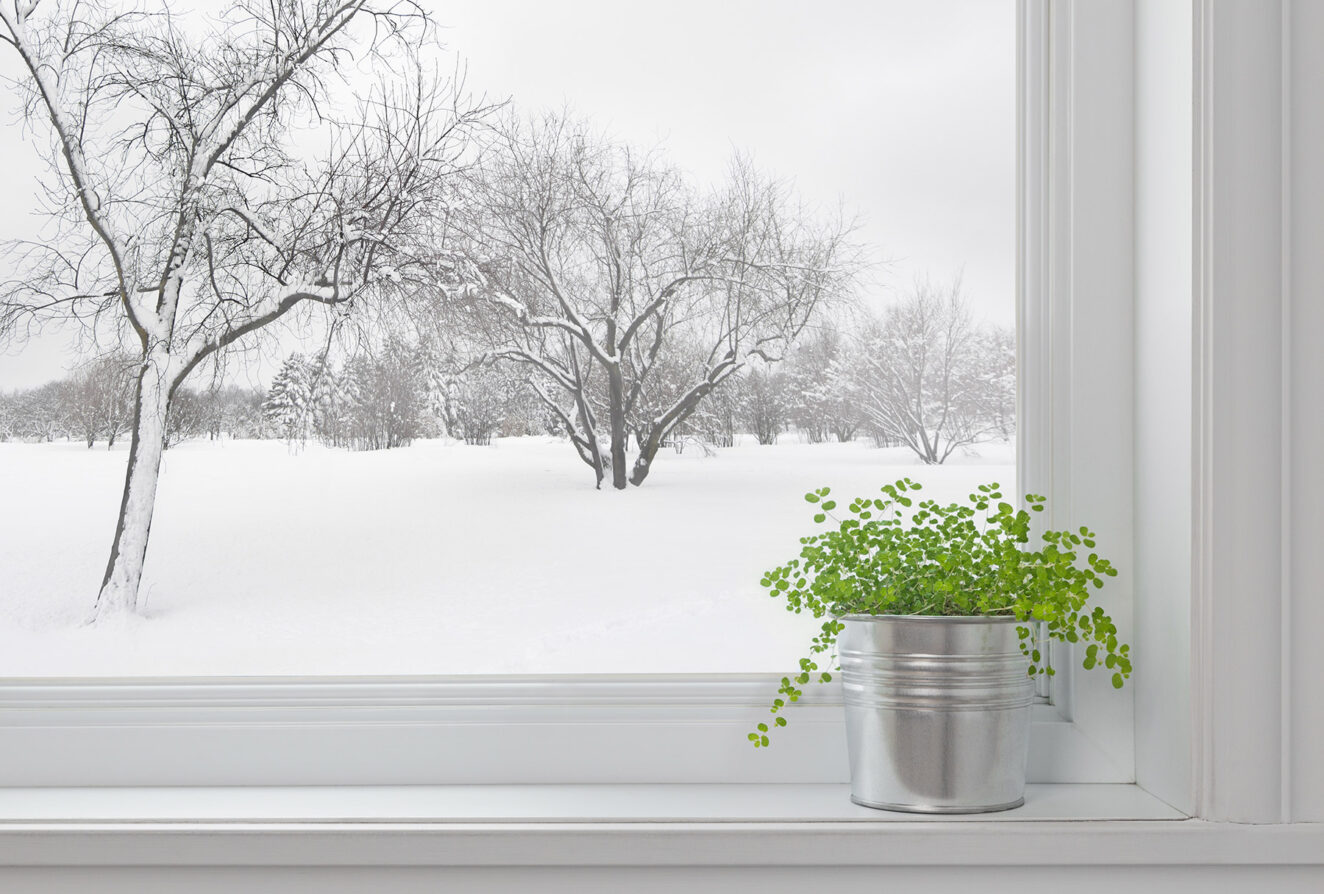
    I tell you this sad story not to dishearten you, but to inform you of the dangers of harsh weather changes on plants. As gardeners, it is not uncommon for you to grow non-native plants, or plant in pots or raised beds outside, which are the most susceptible to weather damage, especially in the winter. So, as the winter solstice comes into few, I have some helpful tips to help you protect your plants from freezing weather.

    Sylvia Briggs-Bauer

    Sophomore at Bellingham High School
    Environmental Youth Activist & Author of
    Columbia Nature News

    Sylvia is a member of the Whatcom Horticultural Society and contributor to our newsletter. She is a 10th-grade student at Bellingham High School who caught our eye through her informative creation of the Columbia Neighborhood Nature News. We are excited to work with her! To find out more about Sylvia Briggs-Brauer, click here to check out the Whatcom Talks article.

  • Plant Hardiness Zones


    Written by Sylvia Briggs-Bauer

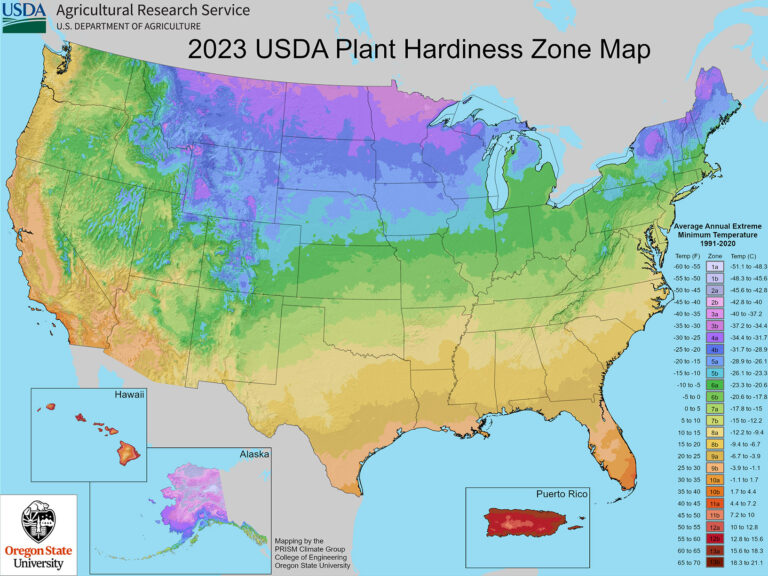
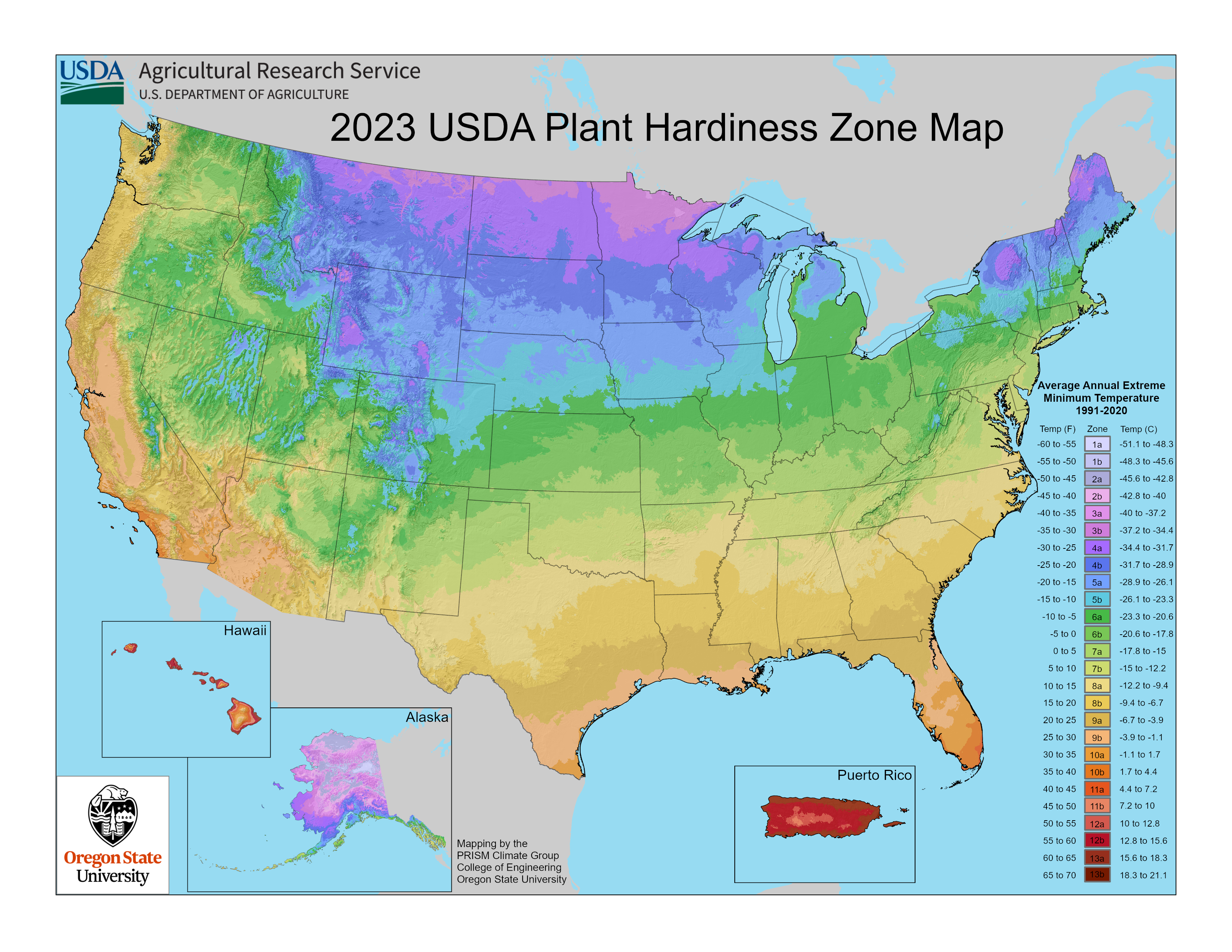
    As you are most likely familiar, the USDA organizes different climates for growing plants in the United States as zones. Areas are color coded on a map from 1A – coldest temperatures- to 13B – warmest temperatures. You can easily search up a map of these zones online if you are interested. The Bellingham-Whatcom County area is shaded in yellow, which represents 8A/8B. This will not come as a surprise; our climate is moderate. Based on this information, you can figure out how much protection a plant needs in the winter months depending on what zone your species of plant typically grows in. 

    Sylvia Briggs-Bauer

    Sophomore at Bellingham High School
    Environmental Youth Activist & Author of
    Columbia Nature News

    Sylvia is a member of the Whatcom Horticultural Society and contributor to our newsletter. She is a 10th-grade student at Bellingham High School who caught our eye through her informative creation of the Columbia Neighborhood Nature News. We are excited to work with her! To find out more about Sylvia Briggs-Brauer, click here to check out the Whatcom Talks article.

  • Options for Potted Plants


    Written by Sylvia Briggs-Bauer


    A rule of thumb for potted plants is if a plant is rated two zones lower than the zone you live in, it is most likely to survive the winter outside in a pot – for example trees and shrubs.  However, it is better to be safe than sorry, especially if you don’t know for sure what zone the plant is rated as. Bringing potted perennials inside is most advantageous. Even placing your plant in a non-heated shed or garage with bubble wrap beneath to insulate the plant from the cold ground is a fantastic option. This also ensures a ceramic pot will not break in the freezing temperature. If this is not possible (you don’t have room, your pots are too large, etc.) you can shelter potted plants in huddles with dried leaves. Placing a plastic ani-freeze tarp or a sheet over plants can also increase temperatures by two degrees!

    Sylvia Briggs-Bauer

    Sophomore at Bellingham High School
    Environmental Youth Activist & Author of
    Columbia Nature News

    Sylvia is a member of the Whatcom Horticultural Society and contributor to our newsletter. She is a 10th-grade student at Bellingham High School who caught our eye through her informative creation of the Columbia Neighborhood Nature News. We are excited to work with her! To find out more about Sylvia Briggs-Brauer, click here to check out the Whatcom Talks article.

  • About Protecting Garden Beds and Moving Bulbs


    Written by Sylvia Briggs-Bauer

    When in doubt, just cover your garden with dry leaves or mulch! Bulbs (for example tulips) can be dug up from pots and moved to garden soil, or stored inside to dry and be planted in the spring. You will discover that in some years you will dig up many more bulbs than you planted!  Other perennials with underground storage structures such as irises are usually hearty enough to survive a freeze if they are planted in the ground. Chicken wire over flower bulbs, and then dry leaves on top is a very smart way to protect them from nibbling squirrels and the cold – the former more likely in our climate than the latter. 

    Sylvia Briggs-Bauer

    Sophomore at Bellingham High School
    Environmental Youth Activist & Author of
    Columbia Nature News

    Sylvia is a member of the Whatcom Horticultural Society and contributor to our newsletter. She is a 10th-grade student at Bellingham High School who caught our eye through her informative creation of the Columbia Neighborhood Nature News. We are excited to work with her! To find out more about Sylvia Briggs-Brauer, click here to check out the Whatcom Talks article.

  • Spring Lecture Series ~ April 29 ~ Seamus O’Brien

    Seamus O’Brien

    Kilmacurragh: The Evolution of an 18th Century Irish Garden and its Spectacular Meadows”

    Tuesday April 29, 2025
    Whatcom Museum • 121 Prospect Street
    7:30pm • Doors open at 7
    Tickets: $10 Members • $15 General
    Get your tickets online here (ticket sales will open soon) or at the lecture.

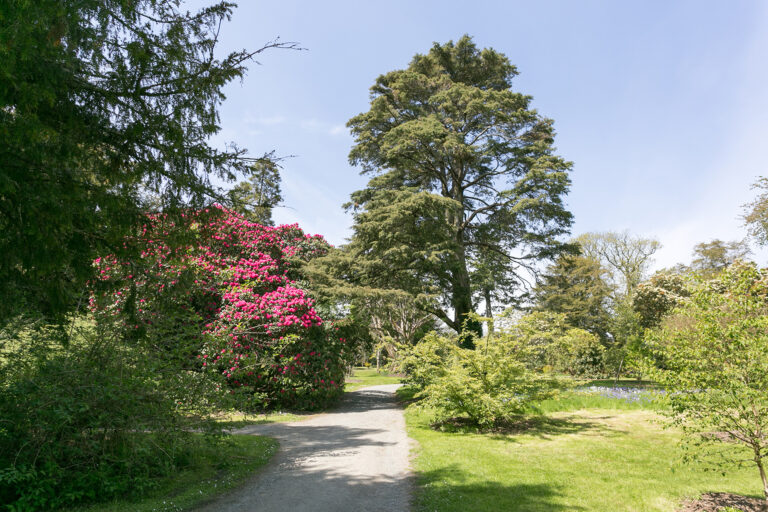
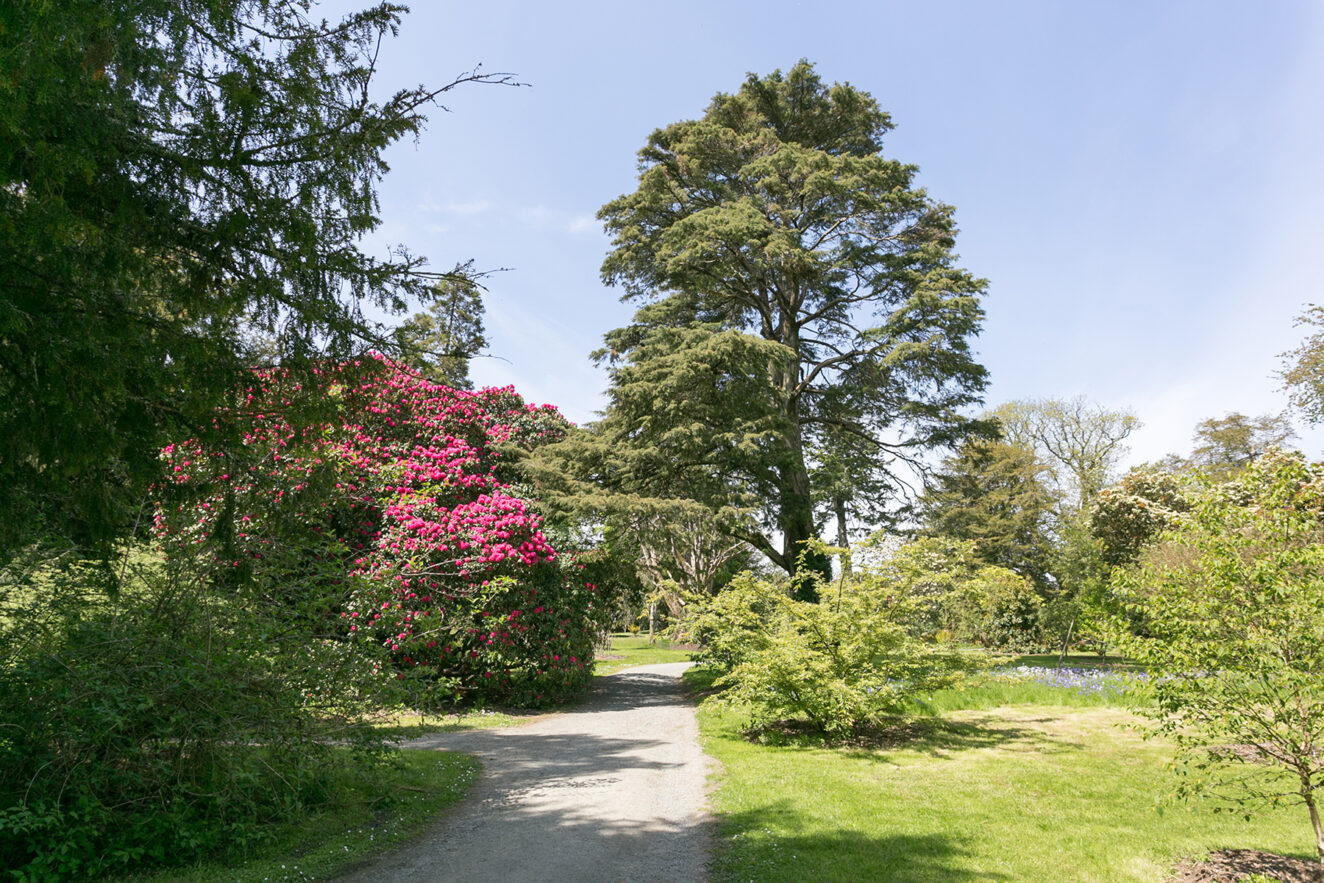
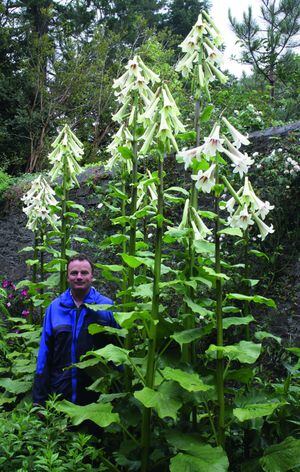
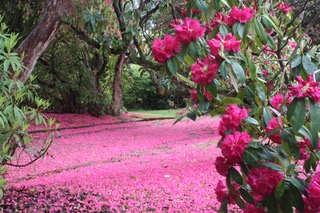
    We are exceptionally excited to welcome you to this engaging lecture by Seamus O’Brien, one of Ireland’s best-known horticulturists and Head Gardener of the National Botanic Gardens, Kilmacurragh, County Wicklow. This garden estate is famous for its conifer and extensive rhododendron collections, and under Seamus’s direction, is being restored.

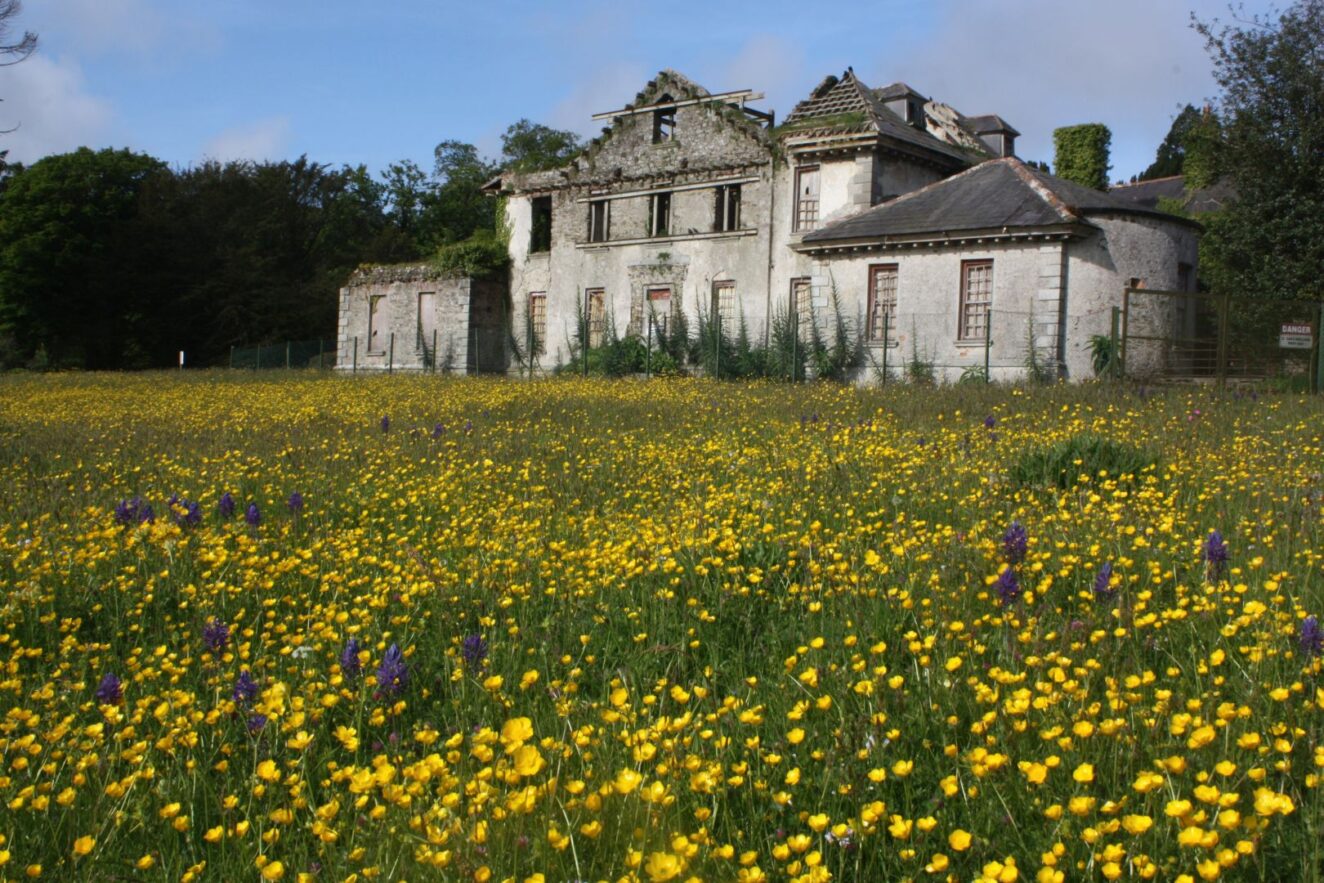
    The recent rejuvenation of the dramatic Kilmacurragh native wildflower meadows is one of the highlights of this talk. Seamus will describe the process and the unique plants employed to create the colorful tapestry of ever changing seasonal wildflowers that includes snowdrops, crocuses, narcissi, and native orchids.

    We will also enjoy a glimpse into the evolution of Kilmacurragh with its rich and fascinating history dating back to monastic origins in the 1600s. In the 19th century it became a wild-style ‘Robinson’ garden when the latest discoveries of plants and exotic trees from world expeditions were added. Recently the gardens have undergone a major replanting program using material raised at multiple botanical gardens from worldwide collaborative expeditions.

    Seamus has travelled extensively to many areas of the world to study plants in their native habitats. From these expeditions he has published two award winning books: In the Footsteps of Augustine Henry and his Chinese Collectors (2011), and In the Footsteps of Joseph Dalton Hooker: A Sikkim Adventure (2018). He is a regular contributor to Curtis’s Botanical Magazine, The Irish Garden, The Irish Garden Plant Society Newsletter and the International Dendrology Society Year Book.

    For additional information and a look at the wildflower meadow garden https://www.youtube.com/watch?v=mlbbtqEl67E

    Seamus O’Brien Lecture Tickets April 29, 2025

  • Fall Lecture ~ November 7 ~ Cindy Funes

    Cindy Funes

    “Winter Beauty: Crafting Showstopping Container Gardens for the Cold Season”

    Thursday November 7, 2024
    Whatcom Museum • 121 Prospect Street
    7:30pm • Doors open at 7
    Tickets: $10 Members • $15 General

    Cindy Funes

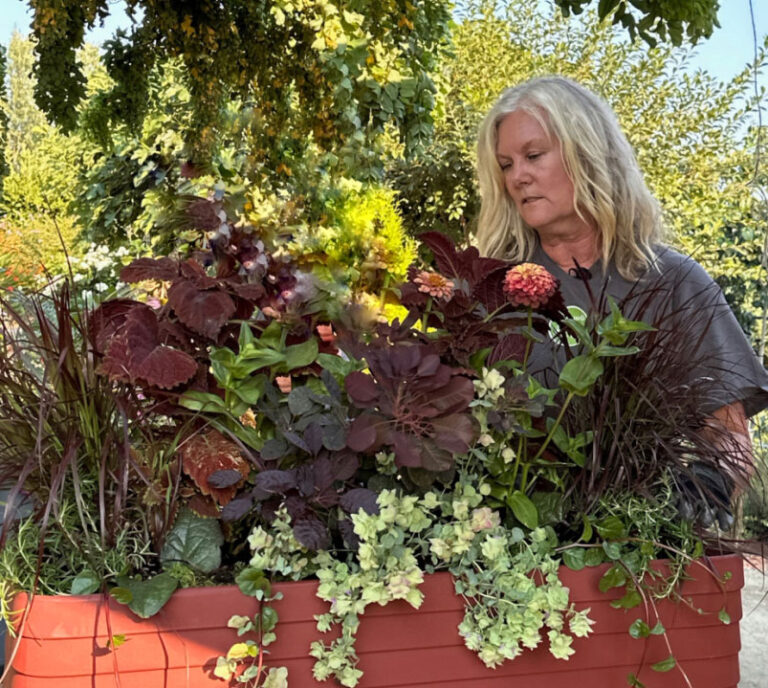
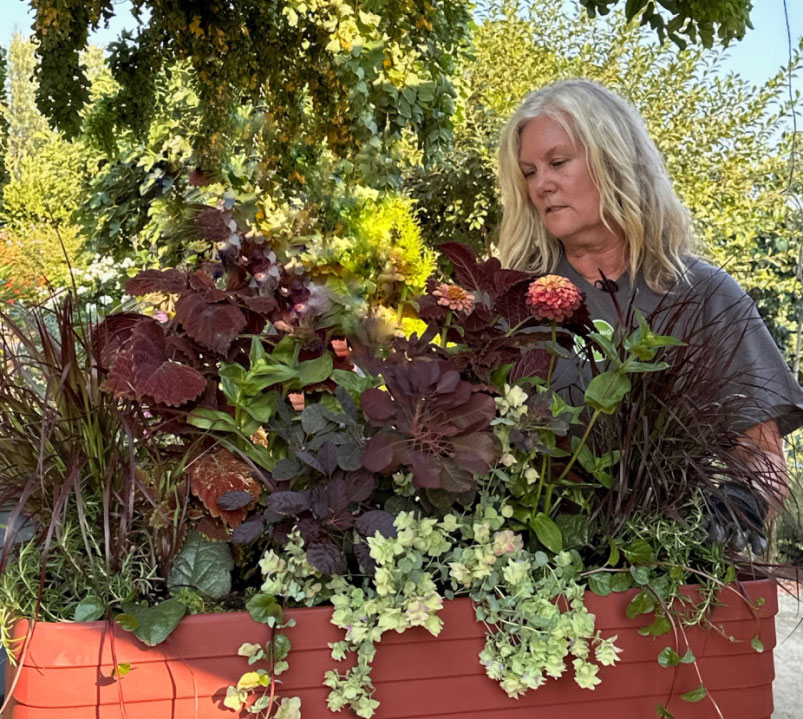
    Get ready to be inspired with this combination slideshow and demonstration planting of a spectacular winter container presented by Cindy Funes, an award-winning container garden designer. (This container is the evening’s raffle!). Cindy’s winter designs focus on texture and color, and the pots are underplanted with spring blooming bulbs to add further interest and additional pops of color later, while the rest of the landscape still remains quiet.

    Cindy is a certified professional horticulturalist, award-winning container garden designer, and owner of Garden Revelry LLC. With over 15 years of experience designing, installing and maintaining container gardens in the Pacific Northwest, Cindy excels in creating unique, lush plantings that complement and transform living spaces. Cindy has appeared in several podcasts, live interviews, and articles. Her blog posts, videos, and classes are treasure troves of pro-tips, infused with vibrant visuals and best practices to help gardeners become more accomplished container gardeners, transforming gardening from a chore into pure joy.

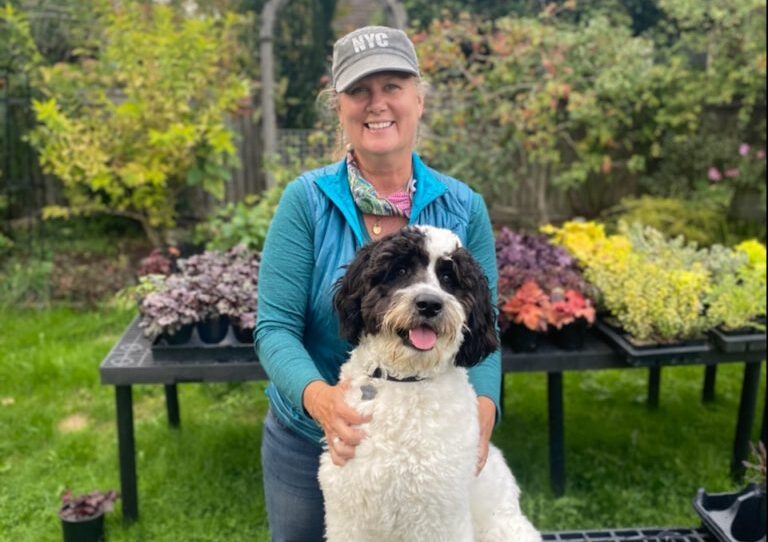
    Cindy Funes with her garden dog

    Her mission is to foster love for container gardening, offer practical advice and inspire creativity. Cindy enjoys spending time in her garden, hiking, playing cards with friends, and hanging out with family and Tucker, her faithful companion. Her website, Garden Revelry, is filled with resources and inspiration.

    Each lecture ticketholder will be entered into a raffle to take home the demonstration pot Cindy creates for us!


    Cindy Funes Lecture Tickets for November 7

  • Consider the Ground Cover

    Written by Sylvia Briggs-Bauer

    A lawn has many purposes. It’s soft and comfortable to lie on, it stays healthy when it’s stepped on, and it is perfect for picnics and cartwheels and year-round fun. When considered from an environmental perspective…well…its better than dirt! I am here to tell you, however, that there is an even better solution. A beautiful and more environmentally friendly alternative which takes some time at first, but its worthy and less time-consuming in the long run. I’m talking native groundcovers.

    To start, native plants need a much smaller volume of water than most decorative or nonnative options – including turf grass. According to the EPA, if an average-size lawn is watered for 20 minutes a day for one week, it’s equivalent to about 800 showers!! Though not everyone waters their lawn consistently, 20 minutes is quite common especially during summer months. On the other hand, once they are well established, native plants need little water! Another reason to choose native groundcovers is they do not need to be mowed or chemically treated. Hence no electricity or gas is expended, and there is less work for you! Lawn fertilizers can be harmful to ecosystems when rainwater washes them into storm drains, but native gardens do not and should not have these products included in their care. Finally, native plants attract native pollinators to your garden. This past spring, my own garden was visited by many native bugs including a yellow and dark orange bee who especially enjoyed the flowering fairy bells!

    Consider turning some of your own lawn into native groundcovers! Click here for a Washington state native groundcover list.

    Sylvia Briggs-Bauer

    Sophomore at Bellingham High School
    Environmental Youth Activist & Author of
    Columbia Nature News

    Sylvia is a member of the Whatcom Horticultural Society and contributor to our newsletter. She is a 10th-grade student at Bellingham High School who caught our eye through her informative creation of the Columbia Neighborhood Nature News. We are excited to work with her! To find out more about Sylvia Briggs-Brauer, click here to check out the Whatcom Talks article.